Skip to content

STANDARDIZED EXAM ARCHITECTURE

The Gateway to Medical Education

The Medical College Admission Test (MCAT) is a standardized, computer-based examination developed and administered by the Association of American Medical Colleges (AAMC). Required by nearly all U.S. and Canadian medical schools, the MCAT evaluates prospective physicians on prerequisite science concepts, foundational principles of human behavior, and critical reasoning abilities.

Rather than testing pure rote recall, the exam evaluates Scientific Inquiry and Reasoning Skills (SIRS) across multi-step, passage-based problem sets. Scoring is normalized across four equally weighted domains on a scale of 118 to 132 each, combining into a total composite score from 472 to 528.

LOCAL & STAGING EVALUATION ONLY EXPERIMENTAL_LICENSE_BLOCKED

EDUCATIONAL MOTION MASTER

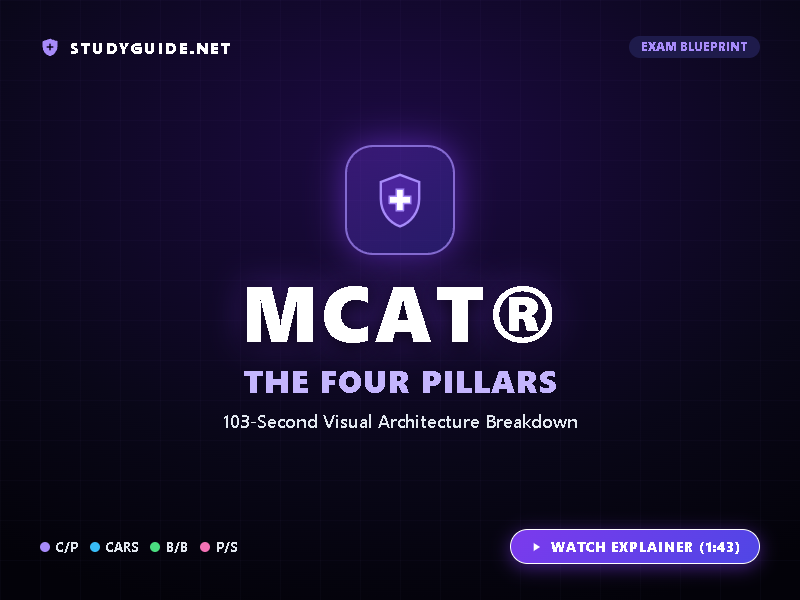
The Four Pillars of the MCAT: Exam Architecture & Question Mechanics

Watch this concise 103-second visual blueprint explaining section weighting, passage vs. discrete question mechanics, and admissions scoring principles.

View Complete Video Transcript (15 Pedagogical Beats)

[0:00–0:10] The High-Stakes Gateway: The Medical College Admission Test, or MCAT, is the critical gateway to medical school in the United States and Canada. Unlike undergraduate exams that reward memorization, the MCAT evaluates scientific inquiry, data analysis, and reasoning skills under rigorous timed conditions.

[0:10–0:22] Standardized Blueprint: Developed by standardized exam authorities, the MCAT serves as a common denominator for admissions committees evaluating applicants from diverse academic backgrounds. The exam consists of four distinct sections, each testing foundational domains essential for clinical practice.

[0:22–0:34] Pillar One: Chemical & Physical Foundations: Chemical and Physical Foundations of Biological Systems tests the mechanics of living organisms through general chemistry, organic chemistry, physics, and biochemistry. You will analyze complex physiological systems using quantitative problem solving.

[0:34–0:46] Pillar Two: CARS: Critical Analysis and Reasoning Skills evaluates your ability to comprehend, analyze, and synthesize arguments across the humanities and social sciences. Uniquely, CARS requires no outside scientific knowledge; every answer is derived entirely from the passage text.

[0:46–0:58] Pillar Three: Biological & Biochemical: Biological and Biochemical Foundations of Living Systems examines cellular processes, molecular biology, genetics, and organ systems. Questions demand an understanding of both micro-level biochemistry and macro-level physiology.

[0:58–1:10] Pillar Four: Psychological & Social: Psychological, Social, and Biological Foundations of Behavior explores the social determinants of health, behavioral psychology, and societal structures. Future physicians must understand how socioeconomic factors and psychology influence patient health outcomes.

[1:10–1:25] Question Mechanics: The exam combines two distinct formats: passage-based problem sets and standalone discrete questions. Across the science sections, you will navigate approximately thirty complex passages paired with multi-step analytical questions, alongside isolated discrete items testing core concepts.

[1:25–1:35] Balanced Scoring: Each section is scored on a scale from 118 to 132, yielding a total composite score from 472 to 528. Because no section is weighted above another, balanced mastery across all four domains is essential for a competitive application.

[1:35–1:43] Strategic Roadmap: Master the question formats, build disciplined passage pacing, and explore comprehensive preparation on StudyGuide.net.

Legal Disclaimer: Educational reference based on publicly available exam specifications published by the Association of American Medical Colleges. StudyGuide.net is an independent educational publisher and is not endorsed by or affiliated with the AAMC.
DETAILED DOMAIN BLUEPRINT

The Four Core Sections of the MCAT

Each 90- to 95-minute testing block tests foundational science principles integrated into living systems, alongside rigorous text analysis.

PILLAR ONE C/P

Chemical and Physical Foundations of Biological Systems

⏱ 95 Minutes 📝 59 Questions 📊 118–132 Scale

Tests mechanics of the human body through principles of general chemistry (30%), introductory physics (25%), organic chemistry (15%), biochemistry (25%), and general biology (5%). Questions require calculating physical values and analyzing bio-energetic transformations.

  • General & Organic Chemistry
  • Foundational Physics
  • Enzyme Kinetics
PILLAR TWO CARS

Critical Analysis and Reasoning Skills

⏱ 90 Minutes 📝 53 Questions 📊 118–132 Scale

Evaluates critical reading and analytical reasoning across passages drawn from the humanities (50%) and social sciences (50%). Uniquely requires zero prerequisite science knowledge; all questions test your ability to infer tone, analyze arguments, and adapt logic to new scenarios.

  • Humanities & Ethics
  • Social Commentary
  • Argumentative Logic
PILLAR THREE B/B

Biological and Biochemical Foundations of Living Systems

⏱ 95 Minutes 📝 59 Questions 📊 118–132 Scale

Tests biochemical processes that sustain life: cell biology and genetics (65%), biochemistry (25%), organic chemistry (5%), and general chemistry (5%). Questions focus on molecular interactions, organ system homeostasis, and experimental lab assays.

  • Molecular Biology
  • Metabolic Pathways
  • Genetics & Physiology
PILLAR FOUR P/S

Psychological, Social, and Biological Foundations of Behavior

⏱ 95 Minutes 📝 59 Questions 📊 118–132 Scale

Investigates how biological, psychological, and sociocultural factors influence human perception, cognition, and well-being. Covers introductory psychology (65%), sociology (30%), and biological psychology (5%), with heavy emphasis on research methods and health disparities.

  • Behavioral Psychology
  • Sociology & Demographics
  • Research Methodology

COGNITIVE RIGOR & FORMATS

Question Mechanics: Passage Synthesis vs. Standalone Discretes

The MCAT contains 230 total multiple-choice questions. Across the three natural and behavioral science sections, questions are divided into two distinct testing formats:

  • Passage-Based Problem Sets (~176 Questions): Each science section includes approximately 10 passages (CARS includes 9), followed by 4 to 7 questions. Passages describe experimental setups, clinical case studies, biochemical figures, or research data that require real-time interpretation.
  • Standalone Discrete Questions (54 Questions): Grouped between passage sets, discrete questions test independent scientific recall, formula application, and concept definitions without an accompanying text passage.

Questions test four hierarchical Scientific Inquiry and Reasoning Skills (SIRS): Knowledge of Scientific Concepts (35%), Scientific Reasoning & Problem Solving (35%), Reasoning About Research Design (10%), and Data-Based & Statistical Reasoning (20%).

76%

Passage-Based Synthesis

Requires digesting novel charts, blot assays, and scientific texts under strict time constraints.

24%

Standalone Discretes

Direct foundational science recall questions distributed across C/P, B/B, and P/S sections.

SCALED EVALUATION

Understanding the 472 to 528 Scoring Scale

Medical admissions evaluate both composite performance and subsection harmony across the four domains.

SECTION SCALE

118 – 132

Each of the four sections receives a scaled score from 118 (lowest) to 132 (highest), with a midpoint of 125.

TOTAL COMPOSITE

472 – 528

Composite score calculated by summing the four section scores. Midpoint is exactly 500. There is no penalty for guessing.

DOMAIN HARMONY

Equal Weight: 25%

Every section contributes equally to the composite score. A severe deficit in any single domain cannot easily be compensated by another.

Admissions Perspective: While competitive score bands vary by institution, medical school admissions committees review individual subsection percentiles alongside composite scores to ensure readiness across both quantitative natural sciences and humanistic critical analysis.

ACTIONABLE STRATEGY

Three-Phase MCAT Preparation Sequence

A disciplined, phased study plan balances content mastery with high-intensity passage conditioning.

01

Foundational Mapping

Complete undergraduate prerequisite coursework in general chemistry, organic chemistry, physics, biology, and biochemistry. Audit individual strengths and establish an AAMC registration timeline.

02

Passage & Inquiry Conditioning

Transition from passive textbook reading to active retrieval and question synthesis. Practice passage pacing (targeting ~8 minutes per passage) and master experimental data analysis.

03

Full-Length Simulation

Simulate realistic 7.5-hour testing endurance under timed Pearson VUE conditions using official full-length diagnostic exams. Calibrate subsection balance and stamina.

VERIFIED STUDY MATERIALS

Official Tools & Vetted Study Materials

StudyGuide separates free official testing body materials from vetted commercial study formats to protect editorial integrity.

Tier 1: Free Official AAMC Resources

OFFICIAL AAMC

What's on the MCAT? Exam Content Outline

The definitive syllabus published by the AAMC detailing every foundational concept, category, and prerequisite topic tested on the exam.

Access Official Syllabus ↗
OFFICIAL AAMC

Free Full-Length Practice Examination

A full-length official practice exam available to all registered students on the AAMC portal, complete with scaled subsection score conversion.

Access Practice Portal ↗
PARTNER RESOURCE

Khan Academy MCAT Video Prep Collection

Over 1,100 free video tutorials and practice passages created in direct partnership with the AAMC covering all biological, physical, and behavioral topics.

Open Free Lessons ↗
FINANCIAL AID

AAMC Fee Assistance Program (FAP)

Qualifying examinees receive reduced registration fees, complimentary official prep products, and waived medical school application fees.

Check Eligibility ↗

Tier 2: Vetted Commercial Study Formats

Editorial Transparency: Free official AAMC tools should form the foundation of every study plan. Commercial resources listed above are evaluated for format utility (structured review reference vs. portable active recall). StudyGuide may receive affiliate commissions on qualifying purchases.

FREQUENTLY ASKED QUESTIONS

Common MCAT Questions Answered

When should prospective medical students take the MCAT?

Most pre-med students take the exam in the spring or early summer of the year prior to matriculation (typically between January and May of the application cycle). This ensures scores are available when primary AMCAS or AACOMAS applications open in June.

What coursework is required before taking the MCAT?

Core prerequisites include one year of general biology, one year of general chemistry, one year of organic chemistry, one year of introductory physics, and one semester of introductory biochemistry. Coursework in introductory psychology and sociology is strongly recommended for the behavioral section.

How many times can an examinee take the MCAT?

The AAMC enforces strict testing limits: up to 3 times in a single calendar year, up to 4 times across two consecutive years, and a lifetime maximum of 7 test administrations. Most medical admissions committees review all past scores or take the latest score.

Can an examinee void their MCAT score on test day?

Yes. Immediately following the conclusion of the fourth exam section, the computer presents a mandatory score void option. If you choose to void, your test will not be scored, and no score record will be transmitted to medical schools, though the attempt counts toward annual testing limits.

Why is balanced section performance so important?

Because the four sections contribute equally (25% each) to the composite score, medical admissions committees evaluate score harmony. An extreme imbalance—such as a 132 in science paired with a 120 in CARS—can trigger screening concerns at competitive institutions.

EXAM CONTEXT Association of American Medical Colleges (AAMC) Official MCAT Registration Portal (opens in a new tab) ↗
ADMISSIONS CONTEXT AAMC Medical School Admissions AMCAS Application & Eligibility Guidelines (opens in a new tab) ↗
EDITORIAL VERIFICATION October 2026 StudyGuide.net is an independent educational publisher and is not endorsed by or affiliated with the AAMC. MCAT® is a registered trademark of the Association of American Medical Colleges.